
Beyond Finance: A Leadership Conversation with Samah Langner Moustafa
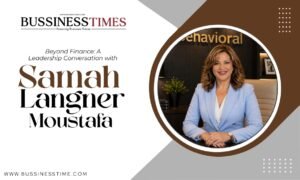
“Growth without structure is simply organized chaos,” believes Samah Langner Moustafa, who is a financial expert, scaling high-growth organizations. As a Group CFO for Go Behavioral LLC, operating across Germany and the United States, she leads financial strategy, operational structuring, and cross-border expansion for fast-growing healthcare organizations. Samah Langner Moustafa knows that, rather than just a reporting tool, corporate finance could be a strong driver for sustainable scaling. Removing the gap between predetermined expansion goals and perfect fiscal discipline, while ensuring that a firm operational foundation powers corporate growth, Samah Langner Moustafa brings a unique international perspective to the healthcare industry as one of the most admired women leaders to watch in 2026.
Before her joining, Go Behavioral LLC was a company with a small team. She scaled it into a multi-location organization with hundreds of employees across multiple states. This rapid expansion required a careful balance of capital allocation and local market compliance. Samah Langner Moustafa managed the financial complexities of this multi-state presence with precision, tracking performance metrics to ensure profitability across all clinics. She treated every new location as a distinct financial unit while maintaining centralized control at the group level. Her strategic leadership allowed the organization to capture new market opportunities quickly without compromising its overall financial health.
Her work goes beyond finance. The systems designed and implemented by her throughout payroll, HR, compliance, and operational workflows ensure growth that is fast, sustainable, and controlled. A rapidly growing workforce, Samah Langner Moustafa understands requires a robust administrative infrastructure to prevent operational bottlenecks, and she minimizes internal inefficiencies by updating corporate workflows and introducing modern payroll automation. To build integrated reporting systems, she collaborates with department heads. These systems provide constant and real-time visibility into company expenses and operational costs, giving executive leaders the required clarity, enabling them to make fast and accurate business decisions.
She is particularly passionate about building infrastructures that support real impact in behavioral health and autism services. She knows that every dollar saved through smart financial management directly improves patient care and therapy access. Her specialized focus areas include financial strategy and control, operational systems and scaling, cross-border business across the US and Europe, and healthcare growth and infrastructure. If you’re building something complex and scaling fast, that’s where she operates best. Samah Langner Moustafa meets regularly with global investors and health networks to discuss how structured capital can expand behavioral healthcare globally, keeping her attention focused on the next phase of international growth.
In an exclusive leadership conversation with Business Times, Samah Langner Moustafa offers deep insights into her mind, her methods, revealing the factors that make her one of the most admired women leaders to watch in 2026.
Samah Langner Moustafa, your professional journey spans finance leadership, operational scaling, and international business transformation. What pivotal experiences shaped your evolution into the leader you are today?
My professional journey started in Egypt in 1997, and from the beginning, I understood that finance was never only about numbers. Working in highly demanding environments taught me discipline, resilience, and the importance of operational structure. As my career evolved internationally, especially through my experience in Germany and later managing operations connected to both Germany and the United States, I learned how different systems, cultures, and regulations influence business performance. One of the most important experiences that shaped me was learning how to manage complexity under pressure.
Leadership is tested most during periods of instability, rapid growth, or operational challenges. Those experiences pushed me to think beyond traditional accounting and focus more on systems, operational discipline, and long-term sustainability. Over time, I realized that the strongest leaders are not the loudest people in the room. They are the ones capable of building structures that continue working effectively even in difficult situations.
As a Group CFO managing financial strategy across Germany and the United States, how do you navigate the complexities of cross-border financial leadership while maintaining agility and governance?
Cross-border leadership requires a balance between flexibility and control. Every country operates differently in terms of compliance, labor laws, taxation, payroll systems, and operational culture. You cannot apply the same mindset everywhere. My approach is based on building scalable systems that create operational consistency while still respecting local regulations and business realities. I focus heavily on communication structures, accountability, workflow design, and financial visibility. When systems are properly designed, organizations can maintain agility without losing governance. For me, governance is not about slowing growth. It is about protecting growth.
You describe yourself as ‘not a traditional CFO’ and emphasize building systems that turn complexity into structured growth. How would you define your leadership philosophy?
I believe leadership is about designing clarity inside complexity. A traditional CFO role is often limited to financial reporting, forecasting, and budgets. While those areas are important, modern organizations need leaders who understand how operations, finance, systems, and people are interconnected. My philosophy is built around one principle: “Control is not something you enforce. It is something you design.” When systems are designed correctly, organizations operate more efficiently, communication improves, and accountability becomes natural instead of forced. I focus on creating operational structures that support sustainable growth rather than temporary success.
Since contributing to the scaling of Go Behavioral from a smaller operation into a multi-location organization, what have been the most critical lessons in managing rapid organizational growth sustainably?
Rapid growth can easily create operational chaos if organizations expand faster than their systems can support. One of the biggest lessons I learned is that scaling is not only about adding more people or opening more locations. It is about building infrastructure capable of supporting growth consistently. This includes financial systems, payroll coordination, operational workflows, compliance tracking, communication procedures, and accountability structures. Without these elements, growth becomes unstable. Another important lesson is that operational discipline protects company culture. When processes are inconsistent, employees become frustrated and disconnected. Strong systems create clarity and stability for teams during periods of expansion.
Your role extends beyond finance into payroll, HR, compliance, and operational workflows. How do you ensure alignment between financial stewardship and operational execution?
I believe finance reflects operational behavior. If operational processes fail, finance will eventually reflect those failures. That is why I work closely with payroll, HR, compliance, and operational teams. Alignment happens when departments stop working independently and start understanding how every workflow impacts the organization as a whole. I focus heavily on operational visibility, communication protocols, approval structures, and accountability. When everyone understands responsibilities and timelines clearly, organizations become significantly more efficient and financially stable.
Behavioral healthcare and autism services are deeply impact-driven sectors. How does working in this field influence your strategic decision-making as a financial leader?
Working in behavioral healthcare changed the way I think about leadership. This industry is not driven only by financial performance. Every operational decision affects therapists, families, children, and the quality of care itself. For me, strong systems are not only business tools. They are part of protecting service quality and operational stability. When payroll is accurate, employees feel secure. When scheduling works effectively, therapists can focus on patient care instead of administrative stress. This industry constantly reminds me that operational structure has a direct human impact.
With increasing digital transformation in finance and operations, what role do automation, systems design, and data intelligence play in the future of CFO leadership?
Automation and systems intelligence are becoming essential for modern leadership. The future CFO cannot operate only as a financial reporter. The role is evolving into operational architecture and strategic systems leadership. Automation reduces human error, improves visibility, and creates operational consistency. However, technology alone is not enough. The real value comes from designing systems that support decision-making and reduce unnecessary operational friction. Data intelligence also allows leaders to identify risks early instead of reacting after problems occur.
What does ‘invisible control’ mean in the context of building organizations that scale effectively without creating operational bottlenecks?
Invisible control means creating systems that naturally maintain alignment without constant supervision. Many organizations depend too heavily on individuals instead of processes. That approach limits scalability. Invisible control focuses on workflow design, communication structures, approvals, compliance tracking, and accountability mechanisms that operate consistently even during growth. It is not about creating pressure or micromanagement. It is about creating operational stability through intelligent design.
As a woman leading in high-level financial and executive decision-making, what barriers have you encountered, and how have those experiences strengthened your leadership approach?
Throughout my career, I worked in environments where leadership expectations were often shaped by traditional perspectives. There were situations where women were expected to stay within limited functional roles instead of broader operational leadership. Those experiences strengthened my discipline and resilience. I learned to build credibility through consistency, operational results, and long-term performance rather than depending only on visibility or titles. I believe strong leadership speaks through structure, results, and impact.
Looking toward 2026 and beyond, what legacy do you hope to create—not only as a financial executive, but as a transformational leader?
I hope my legacy will be larger than financial performance alone. I want to contribute to a different understanding of leadership — one where finance, operations, systems, and human impact are all connected. I want organizations to understand that structure is not the enemy of innovation. Well-designed systems are what allow innovation and sustainable growth to survive. Most importantly, I hope to inspire future leaders, especially women, to think beyond traditional limitations and understand that leadership is not about controlling people. It is about designing environments where businesses and teams can succeed consistently.