
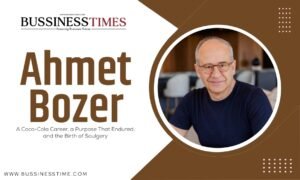
Ahmet Bozer: A Coca-Cola Career, a Purpose That Endured, and the Birth of Soulgery
Organizations invest heavily in leadership development, building technical expertise, strategic capabilities and managerial skills, yet one essential dimension often receives insufficient attention: the human qualities that shape performance and growth. While these qualities have a particularly profound impact in leadership roles, they matter across all roles, and increasingly so in the age of AI.
For Ahmet Bozer, former President of Coca-Cola International, this became the starting point of a new chapter after more than a quarter of a century with the global company. Born in Türkiye, he built an international career that took him across continents and cultures before turning his attention towards human potential.
His journey from global business leadership to exploring human potential led him to questions that extend well beyond the workplace. What makes some people continue evolving while others remain confined by familiar patterns? And as technology takes on more human tasks, which qualities will define our value? These questions sit at the heart of Bozer’s thinking and his book, Soulgery: Self-Surgery of the Soul, opening a conversation about the inner work that determines how people think, lead and live.
Who are you? Could you please brief us about yourself?
I’m Ahmet Bozer, born in Istanbul and raised in Ankara, Türkiye, where I completed high school and college. I moved to the United States to pursue a master’s degree in information technology and began my career there, first as a teacher, then in public accounting, and eventually at The Coca-Cola Company.
I spent a little over a quarter of a century with Coca-Cola, with the opportunity to work on every continent, eventually serving as President of Coca-Cola International, with responsibility for the company’s operations outside North America.
After retiring from corporate life, I turned my attention toward a subject that had fascinated me throughout my life and career: how we can realize more of our potential. That became an eight-year journey of research, reflection, and writing, culminating in Soulgery – Self-Surgery of the Soul: A Lifelong Guide to Unlocking Your Potential. Today, my focus is on sharing the ideas behind Soulgery, driving its adoption and social impact.
You spent more than three decades moving through different roles, countries, cultures, and leadership environments. When you look back, what first drew you toward the question of how people grow, and was there a particular experience that made you realize this was something you wanted to understand more deeply?
As I began thinking about my second career, I initially wanted to share what I had learned about leadership as an executive. Throughout my career, I had always placed leading myself at the foundation of leading others and organizations. So, naturally, I started with the subject of self-leadership.
I soon discovered that the subject was far deeper and richer than I had imagined. What genuinely motivates us to lead ourselves? That question took me beyond leadership itself and into what gives our lives meaning and drives us to grow. This led me to a more fundamental question. What is the ultimate purpose of leading ourselves? I came to believe that it is to realize as much of our potential as we can throughout our lives.
That changed the direction of what I had originally set out to do. What began as an effort to share my learnings about leadership became an exploration of human potential. The outcome was Soulgery.
You have led people and businesses in places as different as India, Russia, Türkiye, the Middle East, Africa, and the United States. What did working across such different cultures teach you about people that you could never have learned from a business school or a leadership book?
Many, but one I’d like to highlight is this: understanding and living what I call the “common currency of humanity” is more important than adapting to different cultures.
I don’t say this to suggest that cultures don’t matter. They do, and we need to respect cultural differences. But underneath them, there’s something we all share, whatever culture we come from. People everywhere want to be respected, included, and recognized. People generally want to do well. If trust is preserved, speed increases. And the list goes on.
I have seen this firsthand. Even when a stakeholder and I had seemingly conflicting goals, extending trust could change the dynamics of our relationship, from protecting our own interests to working together towards a solution that benefited both sides.
At some point, your attention shifted from leading large organizations to understanding the person behind the leader. What were you seeing in yourself and in other leaders that made you feel there was something missing from the way we usually talk about professional growth?
It was the realization that inner work is foundational to everything in life, including your performance as a professional and as a leader.
We spend a great deal of time developing a leader’s knowledge, skills, and behaviours, but much less time becoming more deeply aware of what is happening within us, our thoughts, emotions, and thinking patterns. Developing that capability takes regular inner work.
At the heart of that inner work is understanding how our sense of self can weaken our connections with others, derail our performance, and limit our growth. As we become more aware of this influence and learn to manage it better, we unlock our potential both as a leader and as a human being.
The idea of “self-surgery” is an unusual way to describe personal growth. What does that phrase mean to you personally, and what are we actually trying to change when we examine our thoughts, emotions, habits, and sense of self?
By self-surgery, I mean examining the thoughts you harbor and evolving them, understanding your destructive emotions and learning to channel them toward a useful purpose, and recognizing and rewiring thinking patterns that may be holding you back.
This is like an “operation” on yourself, not on your body but on your inner world. And like surgery, the work can be quite nuanced. Where, for example, do you draw the line between self-confidence and ego? Between pushing yourself to achieve more and burning yourself out?
In performing self-surgery, you won’t always get it right. But as you engage in this kind of metacognitive work, you build those muscles, which in turn help you sustain and accelerate your growth.
You describe growth as something that can come from the experiences we are already living rather than something that requires us to step away from everyday life. How can a busy leader turn an ordinary setback, difficult conversation, or failure into something that genuinely changes them?
This takes us to what lies at the core of self-surgery: reflecting on our lived experiences. The richer your lived experiences, the greater your opportunity for growth, but only if you reflect on them. It is through reflection that you “operate” on your inner world.
Finding time for self-reflection can initially feel difficult. But as you practice it regularly, you begin to wire yourself for reflection. Over time, it happens naturally and eventually becomes less an activity you schedule and more a part of how you live.
You have spent years making decisions where the consequences affected thousands of people and entire markets. Did those experiences change the way you understood yourself, and were there any difficult moments that taught you more about leadership than your successes did?
We naturally tend to learn more from adversity because adversity forces us to stop, question ourselves, and adapt. But I believe it is equally important to learn from our successes. One question I often ask is: how much of this success do I really attribute to myself?
When we consistently over-attribute good results to ourselves, we boost our sense of self. Success can begin to reinforce an inaccurate story about who we are and what we are capable of. That inflated sense of self can make us less open to others, less willing to question ourselves, and less able to learn. Worse yet, when the circumstances that contributed to our success change and our results begin to suffer, we may interpret what is happening in ways that preserve that sense of self rather than question it. That is when decline can begin.
I learned this lesson the hard way. After succeeding in one role, I was promoted to a much bigger one. But I hadn’t fully appreciated how much the circumstances of my previous role had contributed to my success. I carried the same assumptions into the new role, and stumbled. It took a coach to wake me up to what I had overlooked. That experience taught me that success can be just as important to learn from as failure, if we’re willing to examine it honestly.
Leaders are often encouraged to build confidence and a strong sense of identity. Your work also asks us to examine the ways our sense of self can limit us. How can someone tell when confidence is helping them lead and when their own self-image is quietly getting in the way?
There is rarely a clear line between something like healthy self-confidence and a sense of self that has begun to get in our way.
Being approachable, open to feedback, and honest with ourselves are essential. We also need to consider where feedback is coming from, whether someone genuinely cares and is willing to tell us what we need to hear, or has another agenda.
In the end, each of us has to find our own answers, but it comes down to this: making an objective judgment about what was driving us. Was I driven more to do the right thing, or to serve my sense of self, to protect or elevate it? You’re the only one who can make that call in a given situation.
But this isn’t a one-time pass-or-fail test. Life presents us with many such situations, and each gives us another opportunity to look inward. If we reflect regularly and honestly, we can begin to recognize the patterns and gradually become better at keeping the influence of our sense of self in check.
You have seen organizations go through enormous changes over the course of your career, and now AI is changing the nature of work again. What concerns you most about the way businesses are approaching AI, and what do you think leaders risk losing if they focus too heavily on what technology can do?
Organizations may focus so much on what AI can do that they under-leverage what their people can do.
As AI transforms organizations and takes over more of the work currently done by humans, it creates an opportunity to discover and develop more of the latent human capacity within an organization.
That capacity can manifest itself in less-tangible but potentially more valuable ways—inspiring visions grounded in a sense of meaning, brought to life more quickly through AI; stronger relationships, allowing the organization to broaden and deepen its impact; greater resilience; and a stronger capacity for renewal.
So, the question for leaders is how they can use this moment to unleash more of the human power within their organizations. Their biggest challenge may be believing in and pursuing this path even when its tangible results take time to emerge.
If AI can increasingly handle analysis, prediction, execution, and even parts of decision-making, what becomes more important about being human in a leadership role?
Unleashing the human capacity within an organization starts with the leaders themselves. As AI becomes more capable, leaders need to cultivate more deeply the qualities that are uniquely human: our ability to connect with and inspire others, our imagination, and our intuition, to name just a few.
Underlying these qualities are two important foundations. One is what Soulgery calls our Human Equities: love, wisdom, and character. The other is what Soulgery calls Core Skills, sometimes referred to as soft skills. They serve us across the many different roles we play in life. Some examples are listening, asking good questions, and simplifying complexity.
Imagine a leader who listens attentively, asks thoughtful questions, approaches technology with wisdom, and inspires others with a compelling vision of the future. These are distinctly human qualities that technology cannot fully replicate. And as AI takes on more of the work we do today, these qualities will become increasingly important in shaping the value we bring to our organizations.
One of the challenges for any global leader is knowing which principles should remain constant and which should change with the culture, situation, or person. How did you learn to make that distinction, and what can younger leaders learn from it?
I learned this largely through observation and reflection. You observe how you are leading, pay attention to how your leadership resonates with others, and then reflect on what you see. Over time, you begin to discover more about yourself as a leader, and more about the people you are leading.
As you repeat that process across different countries and cultures, you begin to see patterns. Some things clearly need to be adapted: how you communicate or how you respond to local circumstances. But you also begin to recognize similarities that transcend culture, the common currency of humanity I mentioned earlier.
For younger leaders, I would say: observe closely, listen carefully, and reflect regularly. Don’t expect to learn all the answers from a leadership model. Your lived experiences, and your willingness to learn from how others respond to you, will gradually teach you where to draw those lines.
After years of leading at scale, writing Soulgery, and now working on ways to help others apply these ideas, what have you come to believe about the kind of growth that creates not only better leaders, but better human beings?
I believe it is growth founded on what we talked about earlier: the Human Equities of love, wisdom, and character, and Core Skills.
These not only make us better leaders but also better partners, parents, friends, and citizens.
You have recently launched a leadership development programme, The Soulgery Way: A Human Path to Inspiring and Effective Leadership. What inspired you to take the principles of Soulgery into a structured leadership programme, and what can participants expect from the experience?
The Soulgery Way is a natural extension of the ideas I have explored through Soulgery. I have always felt that bringing humanity more deeply into leadership has become increasingly important. As powerful macro forces reshape the world around us, qualities such as meaning, connection, wisdom and character become even more valuable.
Yet, leaders can sometimes feel that giving attention to these qualities comes at the expense of performance. I wanted to address this perceived tension and show how the two can strengthen each other.
The programme is built on a simple belief: the more deeply human we become, the better we perform as leaders.
Over six weeks, participants will take part in a guided learning experience that combines instruction, personal reflection, peer dialogue and practical application. They will explore the ideas behind Soulgery and examine how their inner world influences the way they lead. This includes reflecting on their thoughts, emotions, assumptions and patterns of behaviour, and considering how these affect their judgement, relationships and responses to challenging situations.
The peer dialogue element gives participants an opportunity to exchange perspectives, learn from one another’s experiences and examine leadership challenges through different lenses. Through real-life practice, they will then work on applying these insights to their own leadership situations, including how they communicate, build trust, respond to others and make decisions.
I will bring these discussions to life through experiences drawn from decades of leading one of the world’s most iconic brands across continents and cultures. My intention is to help participants connect the ideas with the realities of leadership and develop habits they can continue practising after the programme concludes.
In due course, I want participants to leave with a deeper understanding of themselves, a clearer sense of the human qualities they bring to leadership, and practical ways to become more inspiring and effective in their roles.
The first cohort is running from October 15 to December 10, 2026.
If a leader reading this interview were to pause today and honestly ask themselves, “What in me is helping my growth, and what in me is holding it back?”, where would you encourage them to begin?
As you read through this interview, pay attention to what resonated most with you. Where did you find yourself thinking, “Yes, I’d like to learn how to do that better”?
Start there.
Growth is deeply personal, and we don’t all need to begin in the same place. What catches your attention may be telling you something about where your greatest opportunity for growth lies. Follow that curiosity, reflect on it, and begin working on it through your lived experiences.