
Christophe T. Spring: The Visionary Strategist Behind Four Decades of Global Growth
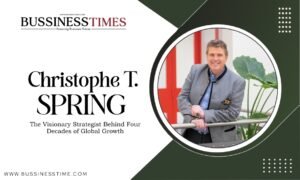
Beyond borders, beyond titles — a career shaped by commercial achievement, cultural intelligence, strategic leadership, and the enduring value of reputation.
For more than four decades, Christophe T. Spring has built an international career spanning more than 36 countries across Europe, North America, the Gulf Cooperation Council (GCC), and Asia. His professional journey has taken him through international sales, market development, premium consumer goods, corporate leadership, and cross-border business relationships.
Four decades. Four languages. More than 36 countries. And one conviction that has remained constant through changing markets, corporate hierarchies, and economic cycles: sustainable business growth begins with understanding people.
For Spring, strategy has never been confined to boardrooms, financial projections, or ambitious expansion plans. It has been shaped by commercial negotiations, cultural differences, difficult leadership decisions, and the ability to recognise opportunities where others may see obstacles.
His approach combines commercial discipline with an instinct for connecting people, industries, and markets. Yet he is equally conscious that opportunities alone create little value without the judgment, credibility, and determination required to turn them into measurable results.
In his view, the true test of a strategist is not how convincingly a vision can be presented, but how effectively it can be executed.
Building Growth Across Borders
Spring’s international career has exposed him to vastly different business environments, negotiating cultures, consumer expectations, and leadership styles.
Experience has taught him that a successful strategy cannot simply be exported from one country to another.
A commercial approach that succeeds in Switzerland may require considerable adaptation in India, the United States, or the GCC. While business objectives may remain consistent, cultural dynamics, distribution structures, decision-making processes, and the expectations of local partners rarely do.
For Spring, cultural intelligence is therefore not an optional leadership quality. It is a commercial necessity.
His experience includes senior responsibilities with internationally recognised brands such as Waterford, Wedgwood, Rosenthal, and Camille Bloch, operating across premium tableware, luxury consumer goods, and Swiss chocolate.
During his leadership of Rosenthal’s Swiss operations, he oversaw eleven Rosenthal Studio Houses and worked with an international portfolio of prestigious brands. That period reinforced his understanding of brand positioning, distribution excellence, retail performance, and the importance of maintaining commercial relevance in competitive markets.
Moving between industries also taught him that established success does not automatically translate into future success.
Every market requires renewed observation. Every industry has its own commercial logic. Even the strongest brands must continuously earn the confidence of customers and business partners.
For Spring, international growth is ultimately about combining market knowledge with adaptability, sound judgment, and disciplined execution.
Strategy Begins Where Comfortable Conversations End
Throughout his career, Spring has experienced both the rewards and consequences of direct leadership.
He has challenged decisions, questioned established assumptions, and spoken openly when he believed an organisation was moving in the wrong direction.
Not every such conversation ended comfortably. Some carried significant professional consequences.
Yet those experiences reinforced a principle that continues to shape his approach: leadership cannot be reduced to agreement, hierarchy, or the avoidance of difficult subjects.
A leadership team surrounded exclusively by people who confirm existing assumptions risks losing contact with commercial reality.
Equally, organisational change should never be confused with genuine progress.
Restructuring, replacing experienced employees, or introducing new management structures may create the appearance of movement. Whether such measures improve performance, preserve essential knowledge, or strengthen an organisation is a different question.
Spring believes effective leadership requires the courage to distinguish between activity and achievement. It also requires responsibility towards the people affected by decisions.
Difficult conversations can be conducted with dignity. Accountability can coexist with empathy. Commercial discipline need not come at the expense of mutual respect.
His philosophy is straightforward: strong leadership is demonstrated not only by the decisions a person makes, but by the manner in which those decisions are carried out.
When Reputation Becomes an Asset
One of the defining lessons of Spring’s career emerged from an unexpected professional setback.
After a difficult departure from a senior position, another opportunity materialised just 28 days later.
It was not the result of an elaborate campaign or a carefully orchestrated professional reinvention. It emerged through relationships, credibility, and a reputation developed over many years.
People remembered his work, his commercial capabilities, and the way he had conducted himself.
For Spring, the experience demonstrated something that traditional financial reporting rarely captures adequately: reputation is an intangible asset with tangible commercial consequences.
Professional titles can disappear overnight. Organisational structures can change. Business cards can become obsolete.
But credibility, once established through consistent behaviour and results, can retain its value long after a particular position has ended.
That understanding has influenced how Spring approaches colleagues, business partners, and professional relationships.
He believes that people remember far more than commercial outcomes. They remember whether commitments were honoured, whether difficult circumstances were handled fairly, and whether they were treated with respect.
Over time, those experiences shape a professional reputation more powerfully than any corporate title.
For Spring, reputation is not something to be manufactured through visibility. It is something earned through conduct.
Connecting Business, Diplomacy and International Opportunity
As his career evolved, Spring’s professional network expanded beyond traditional commercial relationships.
Today, his international connections include entrepreneurs, senior executives, ambassadors, ministers, and members of diplomatic communities representing countries across five continents.
These relationships have broadened his understanding of how international business operates beyond conventional corporate structures.
Encounters within diplomatic and international circles, including occasions involving His Holiness Pope Leo XIV and the Apostolic Nuncio, have reinforced his appreciation for humility, cultural awareness, and the importance of listening.
He considers diplomacy and business distinct disciplines, but ones capable of creating complementary value.
Diplomacy can encourage understanding and establish dialogue. Business can translate that dialogue into partnerships, investment, employment, and economic opportunity.
Connecting the two requires more than an extensive contact list. It demands credibility, sensitivity to different interests, and an understanding of when and how meaningful introductions can create mutual value.
Today, this perspective is reflected in two complementary professional responsibilities.
As Vice President and Executive Board Member of Global SME Business Home (GSBH) in Switzerland, Spring focuses on connecting businesses, industries, and international networks, with particular attention to helping small and medium-sized enterprises identify opportunities beyond their domestic markets.
Alongside this responsibility, he has taken on the position of Senior Executive Advisor – Business Development Strategy at Mackwoods Fine Tea, part of the historic Mackwoods Group, whose origins date back to 1841 in Ceylon, now Sri Lanka.
The appointment brings together more than four decades of international commercial experience with the heritage of an established name in Ceylon tea.
In his advisory capacity, Spring contributes his expertise in international market development, strategic partnerships, premium consumer goods, and cross-border business opportunities, drawing on his extensive professional network across Europe, the GCC, North America, and Asia.
His background in FMCG, luxury and premium consumer goods, international distribution, and travel retail provides a valuable perspective on the commercial opportunities available to heritage brands seeking to strengthen their international presence.
For Spring, joining Mackwoods represents more than another professional appointment. It connects his experience in international brand development with a business whose heritage spans more than 180 years.
The challenge is to respect that heritage while identifying opportunities for sustainable commercial development in a changing global marketplace.
His responsibilities at GSBH and Mackwoods reflect a common strategic principle: meaningful growth depends on connecting the right capabilities, relationships, and markets.
For Spring, the objective is not simply to facilitate introductions. It is to help transform relationships into commercially meaningful opportunities.
Collaboration as a Competitive Advantage
In increasingly interconnected markets, Spring considers collaboration a fundamental strategic capability.
Different industries possess different strengths. Different cultures approach problems from different perspectives. Different networks provide access to opportunities that may otherwise remain inaccessible.
The challenge lies in recognising where those capabilities can complement one another.
A well-established local partner can accelerate market entry. A credible introduction can shorten a lengthy business development process. A carefully structured partnership can combine resources, expertise, and market access that neither organisation could achieve independently.
However, Spring distinguishes between networking and genuine relationship-building.
Collecting contacts is relatively easy. Developing relationships based on trust, mutual understanding, and shared commercial objectives requires considerably more time and effort.
He has observed that international business opportunities often develop long before a formal proposal is presented.
They emerge through conversations, professional credibility, shared interests, and the ability to recognise potential at an early stage.
This is particularly important for SMEs seeking international expansion without the resources of multinational corporations.
The right partnership can provide access to knowledge, distribution, credibility, and commercial opportunities that would otherwise require substantial investment.
For Spring, the ability to bring the right people together at the right moment is not a secondary leadership skill. It is an essential part of strategy.
Curiosity: The Discipline Behind Innovation
Beyond his commercial and diplomatic interests, Spring has maintained a strong appreciation for art, architecture, history, culture, and travel.
These interests have influenced how he observes markets and evaluates opportunities. They encourage him to question established patterns, challenge assumptions, and consider alternatives that may not be immediately apparent.
Spring does not regard innovation as something that necessarily begins with technology. He believes it begins with curiosity.
Why does a particular process exist? Why do customers behave differently across markets? What has changed in the competitive environment? Which assumptions have become outdated? What could be achieved through a different approach?
Technology can accelerate innovation, but it cannot replace the judgment required to recognise where innovation is needed. Nor does every new idea deserve implementation.
Successful innovation requires commercial relevance, disciplined evaluation, and the ability to translate an observation into a practical solution.
For Spring, curiosity creates possibilities. Execution determines their value.
Leadership Lessons Beyond the Boardroom
Not all of Spring’s leadership lessons have come from business.
His longstanding interest in animals, particularly dogs, elephants, and horses, has provided an unconventional perspective on trust, consistency, and behaviour.
Dogs demonstrate loyalty and the importance of dependable relationships. Elephants display remarkable intelligence, memory, and complex social bonds.
Horses offer perhaps the most immediate lesson.
They respond to confidence, consistency, patience, and trust. They are sensitive to uncertainty and entirely indifferent to professional titles or corporate hierarchies.
A horse cannot be persuaded by an impressive résumé.
For Spring, that observation translates naturally into leadership.
Authority may establish a formal position, but behaviour determines whether others develop confidence in the person occupying it.
The same principle applies across organisations, cultures, and international teams.
Employees and business partners ultimately judge leaders less by what appears on their business cards than by what they experience through their decisions and actions.
Credibility must therefore be demonstrated consistently. It cannot simply be announced.
Measuring Success Beyond the Business Card
After more than four decades in international business, Spring’s definition of success extends beyond positions held, markets entered, or professional recognition.
Commercial performance remains essential. Sustainable businesses require profitable growth, sound decisions, and measurable results.
Yet he also considers what remains after a particular assignment has ended.
Former colleagues who remain in contact years later. Business relationships that develop into friendships. Partnerships that create opportunities across industries and borders. Teams that achieve results beyond the capabilities of any individual member.
These outcomes are less easily measured, but they form an important part of his understanding of professional achievement.
Spring also recognises the danger of organisations becoming excessively dependent on a single individual, customer, or source of revenue.
Sustainable leadership requires building teams, developing capabilities, sharing knowledge, and creating structures that remain effective beyond any one person’s involvement.
For him, a successful executive should not seek to become indispensable at the expense of the organisation.
The greater achievement is to build something capable of performing, adapting, and growing without constant personal intervention.
That requires confidence in others, a willingness to delegate responsibility, and the judgment to recognise talent.
It also requires the humility to accept that the strongest result is often produced by a team rather than an individual.
The Mindset Behind Four Decades of Global Growth
The international business environment has changed dramatically since Spring began his career.
Technology has transformed communication. Markets have become more interconnected. Competitive pressures have intensified. Access to information has accelerated decision-making while increasing the complexity of strategic choices.
Yet several fundamentals remain remarkably constant.
Businesses still depend on customers. International expansion still requires cultural understanding. Partnerships still rely on credibility. Leadership still demands the ability to make difficult decisions under imperfect conditions.
Spring’s career reflects an understanding that experience becomes valuable not simply through the passage of time, but through the ability to apply accumulated knowledge to new circumstances.
Today, his responsibilities as Vice President and Executive Board Member of Global SME Business Home and Senior Executive Advisor – Business Development Strategy at Mackwoods Fine Tea allow him to combine decades of commercial experience with an international network spanning business, industry, and diplomacy.
His focus is no longer defined primarily by adding another country to a list of more than 36.
It is about recognising where experience can create value, where relationships can unlock opportunities, and where strategic thinking can be translated into sustainable commercial results.
For Christophe T. Spring, the most effective strategist is not necessarily the person who claims to have every answer.
It is the person who knows which questions to ask, which assumptions to challenge, which people to bring together, and when to turn a promising conversation into decisive action.
Titles may open doors. Reputation keeps them open. Results justify walking through them.